
How to Check Criminal History in Boiling Springs
Use the Boiling Springs Police report form when the town agency handled the event. The request does not search a person's full criminal history, and it does not replace the county court docket. A case number and reporting officer name are especially useful because the town form requires detailed inputs.
- Choose accident or incident report on the official BSPD request form.
- Enter the requester information, event date, reporting officer, reason, and facts needed to identify the record.
- Wait for the report to be completed; active investigations are not released through the stated city process.
- Use Cleveland County detention and eCourts for any booking, filed charge, hearing, or disposition.
- Use NCSBI Right to Review for your own fingerprint-supported North Carolina record.
Keep the city report and county case number together. A booking charge can change, while a police incident may never become a filed court case.
Boiling Springs Police Report Form
BSPD provides a live web form without requiring an account. Signing in can save progress or prefill fields, but submission is available without it. The form is for a specific accident or incident report. It is not a person-search tool, court lookup, or criminal-history database.
| Required Field | What to Enter |
|---|---|
| Type of Event | Accident Report or Incident Report |
| Name and Contacts | Requester name, phone number, and email address |
| Event Details | Date, reason for request, and facts that locate the event |
| Reporting Officer | Name of the officer, a required field on the form |
| Email Copy | Optional copy of the submitted form |
The official Boiling Springs police report form shows those fields.
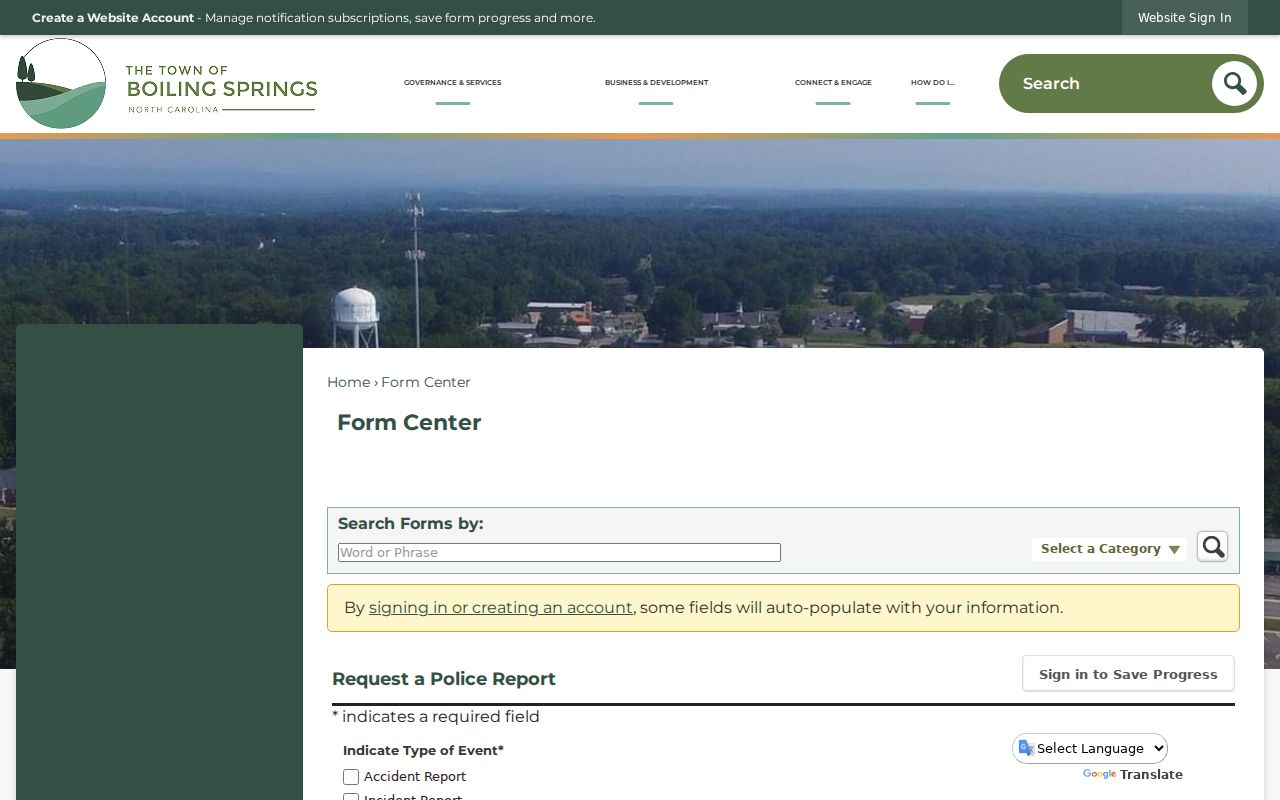
Gather the officer's name before submitting. If it is unknown, call BSPD at 704-434-9691 rather than guessing in a required field.
The Boiling Springs form also asks why the record is requested and offers a checkbox for an email copy of the submission. State the purpose in neutral terms and keep that copy with the report when it arrives. A submitted Boiling Springs form confirms the request, not the truth of an allegation or the existence of a filed charge.
The Boiling Springs Police Department
Boiling Springs Police Department is at 114 E College Avenue. Official town pages render the ZIP inconsistently, while the town footer and mailing address use Boiling Springs, NC 28017. Confirm navigation before a visit. Mail goes to PO Box 1014, Boiling Springs, NC 28017. The police number is 704-434-9691, and emergencies go to 911.
The official BSPD page provides the department contact point.
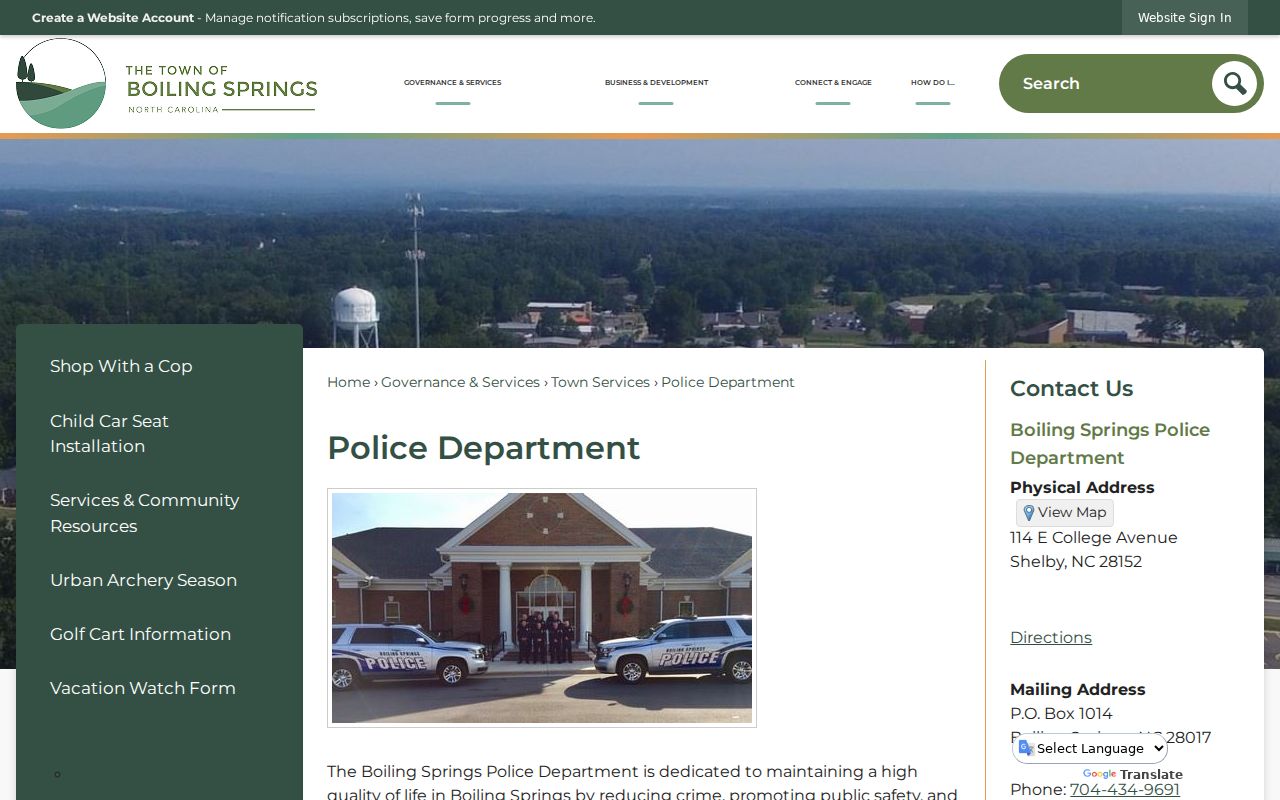
The city police office keeps its agency reports, while post-arrest custody and criminal court records move to Cleveland County offices.
Boiling Springs residents can call the town at 704-434-2357 when a request concerns a non-police municipal record. That town line does not replace BSPD for an incident report. The separate routes reflect different custodians, even when both Boiling Springs offices operate under the same municipal government.
Boiling Springs Report Timing Has Two Clocks
The town's service page says accident reports are typically completed ten business days after the accident, while incident reports may take longer. The Form Center says a completed report is emailed within one to two business days or the requester is called for pickup. Read those statements together.
The ten-day statement concerns creation of an accident report. The one-to-two-day statement appears to concern delivery after the record is complete. Neither means an unfinished or active-investigation report must be released. Ask BSPD whether the file is complete before counting a delivery window.
Note: Completion time and delivery time are separate, so a request sent right after an event may take longer than two business days.
Arrests and Bookings in Boiling Springs
Boiling Springs advertises no town jail and no local custody roster. A BSPD arrest feeds Cleveland County detention. The county P2C Inmate Inquiry can show current custody details such as arrest date, primary charge, and booking agency. The Daily Bulletin covers recent events, while the detention phone line provides a fallback if P2C is unavailable.
A booking entry is not a conviction. It is made at intake and may reflect a charge before prosecutor review. Search eCourts for the filed court case and disposition. Return to BSPD for the city's report because the county jail does not become custodian of the officer's full incident file.
The county-level Cleveland County arrest history page explains those booking channels in more depth.
If the Boiling Springs person no longer appears on the current roster, check the Daily Bulletin for the date of the event and eCourts for the case. Someone sentenced to state custody may later appear in NCDAC Public Offender Search. Those changes track custody stages, not deletion of the original Boiling Springs police report.
Active Boiling Springs Cases Stay Restricted
BSPD says it will not release a report for an event that remains under investigation. North Carolina law supports a distinction between public arrest or incident facts and confidential investigative or intelligence records. A person may receive public portions without obtaining witness interviews, investigative work product, or sensitive leads.
If the requested file is withheld, ask whether the event is still active and whether nonexempt portions can be produced. Do not treat a denial of the full report as proof that no event occurred. Court records may still appear if prosecutors filed a charge.
Boiling Springs Municipal Court Records
Boiling Springs has no municipal criminal court. City ordinance matters, traffic charges, misdemeanors, and felonies enter North Carolina's General Court of Justice. District Court ordinarily handles misdemeanors, infractions, and early felony steps. Superior Court hears felonies. The Cleveland Clerk keeps both files.
| Court Name | No town criminal court; Cleveland District and Superior Courts serve Boiling Springs. |
|---|---|
| Case Types Heard | District Court handles most lower-level and preliminary matters; Superior Court hears felony trials. |
| Case Lookup Channel | North Carolina eCourts Portal or Cleveland Clerk at 704-476-7800. |
| What the Docket Shows | Case events, hearings, parties, assignments, dispositions, judgments, and public documents. |
| Copies & Fees | Public Portal access is free; Clerk copies carry a fee, and a certified county name search costs $25. |
Choose Cleveland County as the Portal location and narrow to Criminal Actions. Use the Clerk for a certified search, older paper record, or copy that cannot be retrieved online.
Boiling Springs case research benefits from the exact Enterprise Justice case number or a careful party-name search. The Portal Register of Actions can show hearings, events, dispositions, and financial entries. It does not expose confidential juvenile files, sealed records, or unreturned warrants. For an official single-county search, Boiling Springs users should submit the Clerk's AOC-CR-314 request with the posted $25 fee.
Boiling Springs Town Records Use Another Form
The police-report web form and the broader town public-record request are not interchangeable. The town's PDF routes Chapter 132 requests to the Town Clerk. It allows the town to seek clarification, charge applicable production costs, or deny access with a statutory basis.
A deposit may be requested when estimated production costs exceed $100. That threshold is not a standard police-report price. For one BSPD event, use the police form. For a town administrative record, use the Town Clerk form. A filed criminal case still belongs to the Cleveland Clerk.
Make a narrow request with a date range, record type, department, and preferred format. Broad wording can raise the cost and time needed to locate town material.
When Boiling Springs withholds all or part of a town record, the PDF process allows a denial with a statutory basis. Ask whether the town can provide a redacted copy or other nonexempt portions. Do not send a Boiling Springs court-document request to the Town Clerk because the General Court of Justice, not the town, keeps that file.
Where Boiling Springs Records End Up
BSPD creates the first agency report. Cleveland County detention creates a booking if there is an arrest. A magistrate handles initial process, the District Attorney reviews charges, and the Cleveland Clerk records filed proceedings and outcomes. Courts then report dispositions for possible matching to state fingerprint records.
Record flow: Boiling Springs Police Department › Cleveland County Courts › North Carolina State Bureau of Investigation
Look to the town report for the event narrative, county P2C for custody, and eCourts for prosecution. A delay or changed charge can make those sources look inconsistent even when each is accurate for its stage.
For identity certainty, a Boiling Springs name search is weaker than a fingerprint-supported personal review. NCSBI receives qualifying fingerprints and court dispositions, then connects them when possible. A person reviewing their own Boiling Springs history should compare the state response with the Cleveland judgment and ask the originating custodian to correct any mismatch.
Boiling Springs Crime Data Is Incomplete
The queried 2023 FBI Crime Data Explorer endpoints for Boiling Springs Police returned null monthly offense values and a null participating-population field. Null does not mean zero crimes. It means that this particular federal series does not provide reportable trend values for the query.
Use the NCSBI official statistics query when looking for other years or state-reported context. For a specific event, rely on the BSPD report and court file. Never turn an empty chart into a claim that Boiling Springs had no offenses.
Boiling Springs Safety Services Are Not Searches
BSPD lists security-check requests, traffic complaints, crime-prevention seminars, and event permits. The Town Hall and Police Department lobby also has a drug take-back box whose contents are collected by the Sheriff, plus a secure document-shredding bin. These are named community services, not tools for looking up a person or obtaining a case.
Use the report form for an accident or incident record. Use a security-check form for the service it names. Call 911 for an emergency. Keeping those channels distinct prevents a report request from being misrouted as a tip or service request.
Boiling Springs History Starts With Water
Town history describes two underground springs about five feet across that once bubbled six to eight inches above the surface. Residents gathered there for picnics, speeches, and even tax payment. Settlement dates to about 1843, a Baptist church to 1847, and a boarding school to 1905.
Boiling Springs incorporated in 1911 with 250 residents. Its first municipal boundary formed a 1.5-mile radius around the school bell tower. The school became Gardner-Webb University, where the spring remains.
The official town history preserves that account.
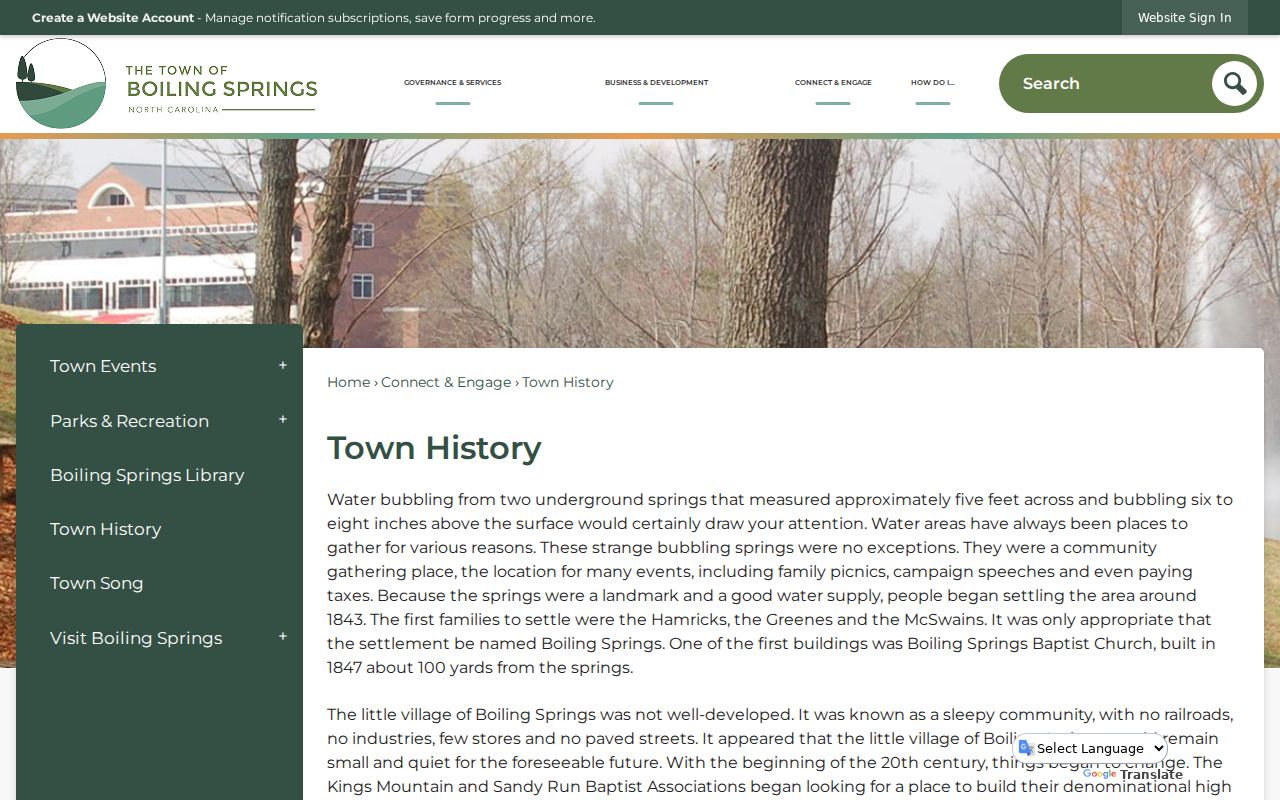
Historic municipal material may belong with the town, but modern police reports go to BSPD and criminal cases go to the county court system.
Public Access Rules for Boiling Springs Records
The North Carolina Public Records Law applies to town records while preserving specific exceptions. G.S. 132-1.4 makes listed arrest and incident information public but treats criminal investigative and intelligence records differently. Juvenile, victim, sealed, and sensitive identifying material may also be withheld or redacted.
Key Statutes:
North Carolina Public Records Law, G.S. 132-1 and 132-6 defines public records and provides for inspection and copies subject to exceptions.
G.S. 132-1.4 separates public arrest and incident information from protected investigative material.
G.S. 7A-109 allows public inspection of court files subject to statutory limits.
Ask the town or BSPD to cite the basis for a denial and to provide nonexempt portions when possible. Court case documents belong with the Cleveland Clerk, not the town request process.