
How to Check Criminal History in Cleveland County
No single screen contains a full Cleveland County criminal history. Begin with the record that best answers the question, then use another official source to confirm it. The North Carolina eCourts Portal shows filed cases and court events. The sheriff's P2C tools show current custody and recent agency events. The Cleveland County Clerk can provide a certified single-county name search, while the North Carolina State Bureau of Investigation offers a fingerprint-based review of your own state record.
Gather the complete name, possible spelling or alias, date of birth when the system permits it, the event date, and any case or OCA number. An OCA number identifies an agency incident. A court case number identifies the judicial file. Those are not interchangeable. Portal supports name and case-number wildcards, but broad searches can mix people with similar names. Match the county, case type, filing date, and disposition before relying on a result.
- Search eCourts Smart Search by party name or exact case number, select Cleveland County, and narrow the category to Criminal Actions.
- Check P2C Inmate Inquiry for current local custody or the Daily Bulletin for a dated arrest or agency event.
- Compare the booking charge with the Register of Actions, hearings, and final disposition in the court file.
- Ask the Cleveland County Clerk for the paper file, copies, or a certified AOC-CR-314 search when formal proof is needed.
- Use NCSBI Right to Review to inspect your own fingerprint-supported North Carolina record and challenge a mismatch.
Cleveland County's Four Record Layers
A Cleveland County records search works best when each source is treated as a separate layer. P2C answers a sheriff or custody question. eCourts answers what was filed and how the court handled it. The Clerk authenticates county court research. SBI CIIS connects fingerprint-supported arrest cycles with reported dispositions. Each product has a distinct custodian, scope, and purpose.
| Channel | Best answer | Main limit |
|---|---|---|
| CCSO P2C | Current custody and recent agency events | Not a complete criminal history |
| eCourts Portal | Filed cases, events, hearings, and outcomes | Not a certified statewide check |
| Cleveland Clerk | Paper files, copies, certified county search | Single-county scope |
| NCSBI CIIS | Your fingerprint-supported state history | Personal review, not a public name portal |
This layered view explains why a booking charge may differ from a later court charge. It also explains why a dismissed case can remain visible until a qualifying expunction is completed. Searchers should preserve the source and date of each result, then verify the final status with the office that created it.
Official North Carolina Background Checks
North Carolina does not offer a general-public SBI name-search portal. For personal review, the NCSBI Right to Review requires the state form and a completed FD-258 fingerprint card. The North Carolina-only review costs $14. A local law-enforcement agency may offer fingerprint capture, but Cleveland County does not publish a verified appointment page or fee. Call CCSO before assuming walk-in service is available.
A certified public name search follows a different path. Submit Form AOC-CR-314 and $25 to the Cleveland County Clerk. It covers the selected county rather than a complete fingerprint record. A national self-review is available through the FBI Identity History Summary for $18 and also requires fingerprints. These official products serve record review and verification. The public search widget is not a substitute for any official check.
| Official product | Scope | Fee |
|---|---|---|
| NCSBI Right to Review | Your North Carolina fingerprint history | $14 |
| FBI Identity History Summary | Your national identity history | $18 |
| Cleveland Clerk certified search | Public court search in one county | $25 |
| eCourts public search | Public case information | Free |
The official personal-review instructions show the fingerprint route and current forms.
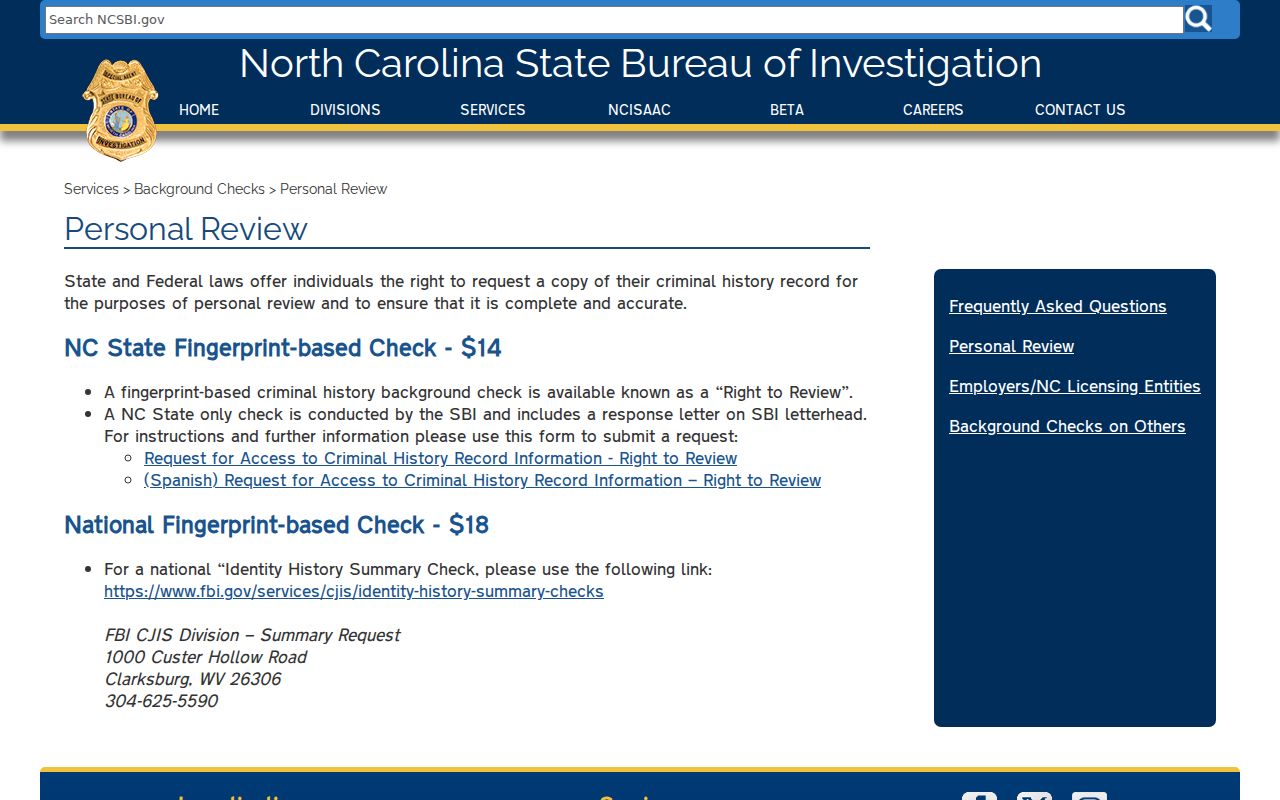
The captured interface helps distinguish a subject's state review from a public court-name search.
Cleveland County Record Offices
Justice Place concentrates several Cleveland County criminal-record functions, but co-location does not merge their files. The Clerk maintains Superior and District Court cases. Sheriff personnel manage agency and detention records. The magistrate handles early judicial process and release conditions. The District Attorney's office is on East Marion Street, and the Public Defender is on Patton Drive.
Cleveland County Clerk
100 Justice Place
Shelby, NC 28150
704-476-7800
Weekdays, 8:30 a.m.-5 p.m.
Sheriff and Law Enforcement
100 Justice Place
Shelby, NC 28150
704-484-4822
Nonemergency routing
District Attorney 39
314 E. Marion Street
Shelby, NC 28150
704-476-7810
Prosecution office
Public Defender
315-B Patton Drive
Shelby, NC 28150
704-476-7979
Defender District 39
The Judicial Branch courthouse page confirms the current court contact point and office hours.
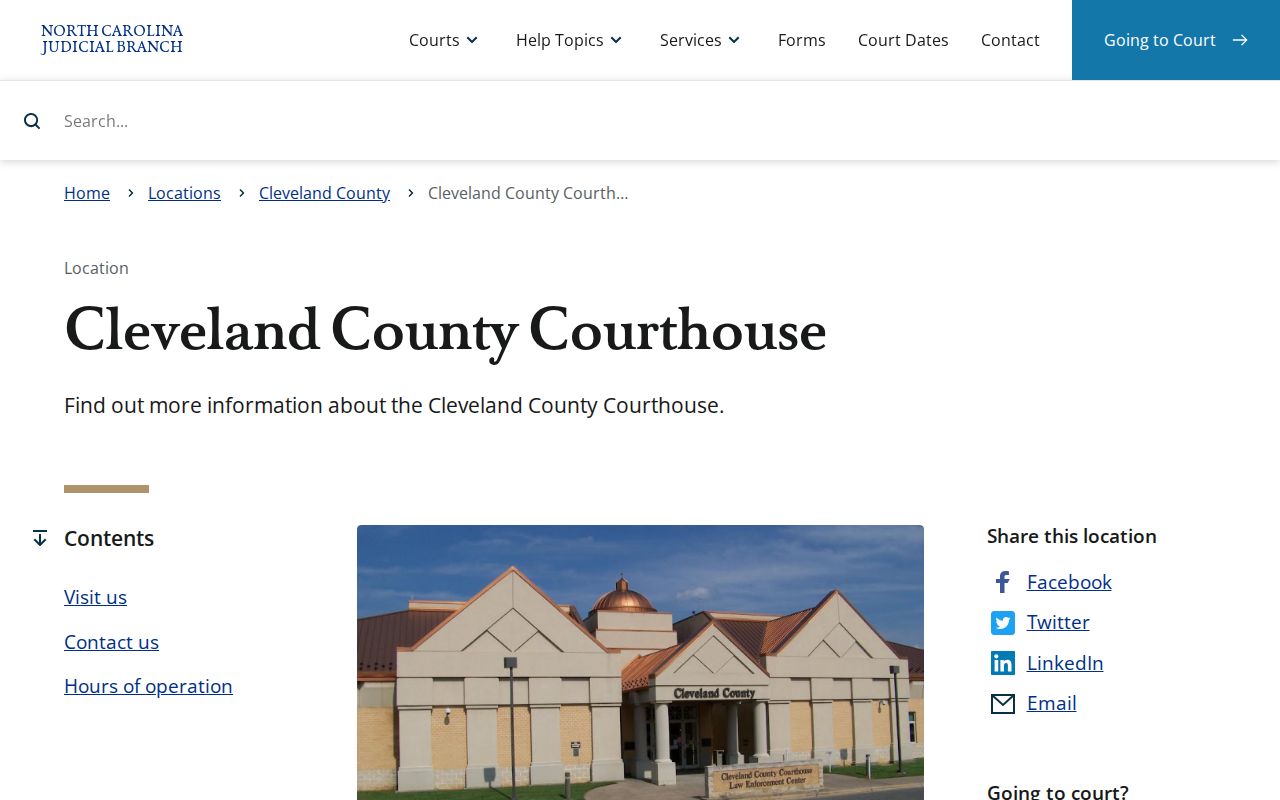
Use the current address while the county's large Justice Center project continues, and check local device rules before visiting.
Types of Criminal Records
Cleveland County criminal records form at different points in a case. An arresting agency creates the incident or arrest report. Detention staff create the booking entry. A magistrate begins the judicial paper trail. The District Attorney decides what to prosecute, and the Clerk preserves the filed case. SBI receives qualifying fingerprints and later disposition reports. NCDAC keeps state prison and community-supervision data, while the sheriff and SBI share registry duties.
The source tells you what the record can prove. An inmate row confirms a local custody entry, not guilt. A court disposition states how a filed charge ended. A fingerprint-based CCH record connects identity to reported arrest cycles but is not open as a public name query. A warrant is judicial process, and a selected Most Wanted list is not the full warrant inventory.
- Incident and arrest reports: held by CCSO, a city police department, campus police, or the State Highway Patrol.
- Bookings: held by Cleveland County detention and summarized in Inmate Inquiry.
- Court case files: held by the Clerk for Superior and District Court.
- Repository history: fingerprint-supported arrest cycles and linked outcomes held by NCSBI.
- Custody and supervision: local jail data at CCSO and state prison, probation, or parole data at NCDAC.
Cleveland County eCourts Record Search
Cleveland County joined the statewide Enterprise Justice system in October 2025. Smart Search accepts a party name or case number. Users can select Cleveland County, choose Criminal Actions, and narrow results by status, case type, date of birth, or filing range. At least three last-name characters followed by an asterisk can help with spelling, while the first name can use one character plus an asterisk. Advanced filters cannot stand alone.
| Portal field | Use | Key note |
|---|---|---|
| Party name | Find a person's case | Use spelling variants and verify identity |
| Case number | Open a known file | Enterprise Justice format is strict |
| Location | Limit the search | Select Cleveland County |
| Case category | Separate record types | Choose Criminal Actions |
| Status and filing range | Narrow the result set | Use with a main criterion |
A result can show assignments, parties, events, dispositions, hearings, and financial information. Search Hearings is better for dates and rooms. Judgment Search provides index entries. Converted events can display midnight when the old system lacked an exact time, and a blank section can simply mean that no data exists there.
What a Cleveland County Criminal Record Shows
The contents depend on the custodian. A P2C booking row reliably shows a name and demographic summary, primary charge, arrest date, and booking agency. The court file adds filed charges, events, hearings, disposition, judgment, and financial entries when applicable. An SBI CCH record uses names, aliases, date of birth, SBI and FBI identifiers, fingerprints, arrest cycles, and linked outcomes. Never assume a field in one product exists in another.
| Name & Identifiers | Names, aliases, date of birth, and repository identifiers where authorized. |
|---|---|
| Arrest / Booking Data | Arrest date, booking agency, demographics, and the primary booking-stage charge. |
| Charges & Statutes | Initial allegations may change before the prosecutor files a court charge. |
| Disposition | The court outcome, such as dismissal, acquittal, or conviction. |
| Sentence | The consequence ordered after a conviction, including custody or probation. |
| Custody / Supervision Status | Local detention at CCSO or state prison and community supervision at NCDAC. |
Four terms prevent common reading errors:
- Disposition
- The formal outcome of a charge or case.
- Nolle prosequi
- A prosecutor's decision not to proceed with a charge at that time.
- Recognizance
- Release on a promise and stated terms rather than deposited security.
- Expunction
- A court-ordered removal of a qualifying record under a specific statute.
Cleveland County Sheriff Record Tools
The Cleveland County Sheriff's Office links the P2C Inmate Inquiry, Daily Bulletin, Most Wanted profiles, and weekly crime maps. Each tool answers a different question. Inmate Inquiry is a current-custody list. The Daily Bulletin is a dated event log. Most Wanted is a selected awareness list, not a full warrant clearance search. Crime-map icons identify reports through an OCA number, incident type, location, and comments, but should not be totaled as official crime statistics.
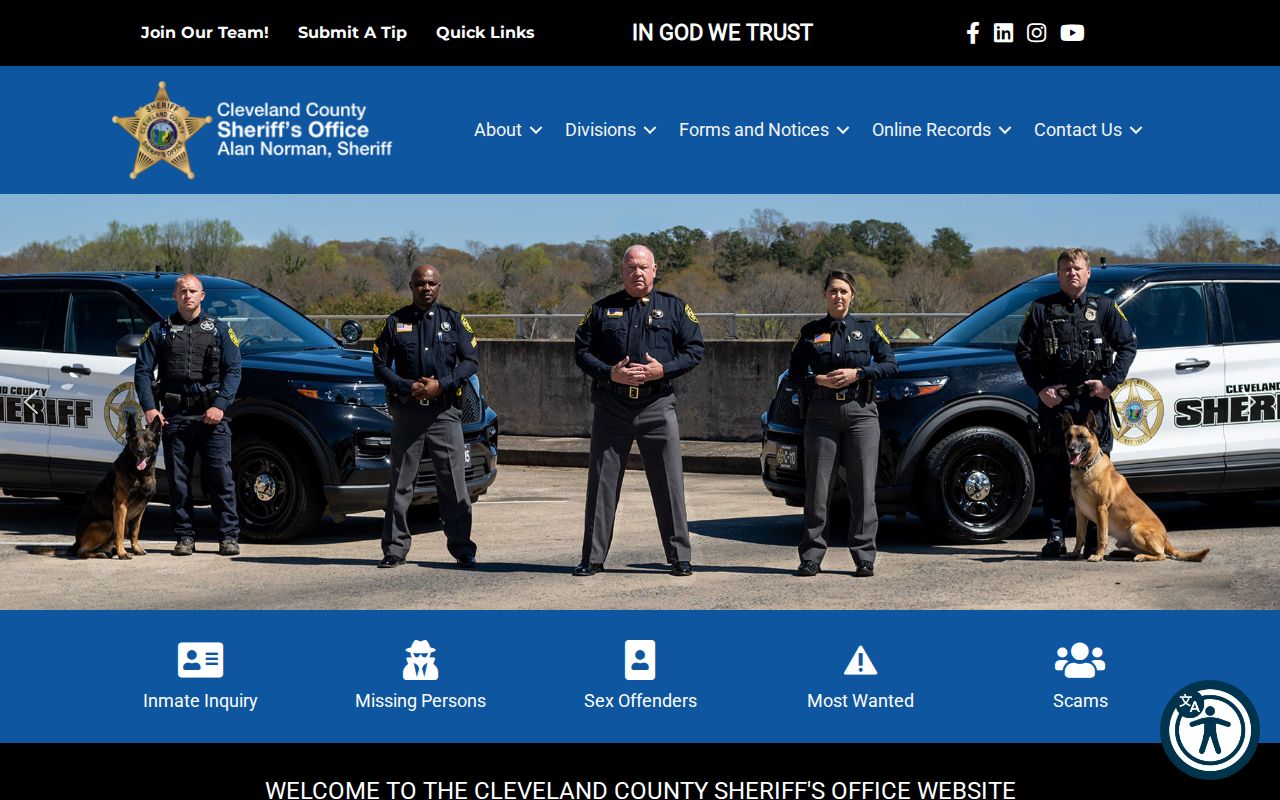
The sheriff page is the trusted launch point for the raw-IP P2C tools.
The official Cleveland County NC Sheriff app is available for iOS and Android. The agency advertises tips, messages, and alerts. Research did not confirm an app-only roster or warrant feature, so the web P2C system remains the verified path for those records.
Public Access Laws
North Carolina Public Records Law starts with access, then applies record-specific limits. Public status does not mean every part of a Cleveland County criminal record appears online. The agency that made or holds the file is the right custodian. The Clerk supplies case documents, CCSO supplies its reports and detention data, a city police department supplies its reports, SBI controls CCH, and NCDAC controls state correction records.
Key Statutes:
G.S. 132-1 and 132-6 define public records and the right to inspect or copy them, subject to exceptions.
G.S. 132-1.4 makes specified arrest and incident facts public but treats investigative records differently.
G.S. 7A-109 governs public inspection of court records, with statutory limits.
G.S. 15A-151 and Article 5 control expunged-record custody and limited disclosure.
Juvenile information, unreturned warrants, sealed cases, protective orders, victim data, Social Security numbers, and confidential investigative work may be restricted or redacted. When only part of a record is exempt, request the nonexempt portion and ask the custodian to identify the legal reason for withholding the rest.
Cleveland County Records Request Fallback
CCSO publishes no distinct online records-request form, fixed copy fee, or promised turnaround. For a sheriff incident report, call nonemergency at 704-484-4822 or control at 704-484-4888 and ask which division holds the record. The Civil Division, on the second floor at 100 Justice Place, handles most incident reports and warrant service. Detention requests begin with the Detention Division and P2C.
Broader county administrative requests must be written. The county accepts email at public.information@clevelandcountync.gov or mail through its public-record request instructions. State the agency, record type, event range, OCA number, names needed for retrieval, and preferred format. Do not send a court case request through that channel. Filed court papers belong with the Clerk.
The county page documents the written fallback when an online record tool does not supply the needed administrative file.
Sealed, Expunged & Restricted
Expunction is North Carolina's statutory term for removing a qualifying record. It is not a correction to one web page. Article 5 contains distinct remedies for certain youthful convictions, qualifying nonviolent convictions, dismissals or not-guilty findings, identity-theft charges, juvenile matters, and other circumstances. Eligibility turns on the exact outcome, excluded offenses, age, waiting period, pending process, and prior relief.
Start with the full case number and certified disposition from the Cleveland County Clerk. Match the facts to the current Article 5 section and Judicial Branch form. File with the Clerk, confirm the current cost, and follow any affidavit, service, record-check, or District Attorney notice requirements. After an order is processed, recheck eCourts and request a new SBI Right to Review. If an official custodian still displays covered information, send that office the order and identifiers.
Note: A dismissed charge may remain visible until a qualifying expunction is entered and processed by the agencies named in the order.
Cleveland County Custody Record Paths
Local and state custody searches are separate. CCSO operates the Cleveland County Detention Center at 407 McBrayer Street and the Law Enforcement Detention Center at 100 Justice Place. Inmate Inquiry lists current local custody by name and can be filtered by race, sex, age, primary charge, arrest date, and booking agency. If the raw-IP portal fails, call Detention at 704-669-3001.
A sentenced person who transfers out of Cleveland County custody may appear in the NCDAC Public Offender Search. That system also covers state probation, parole, and post-release supervision information. It does not replace the local booking row or court judgment.
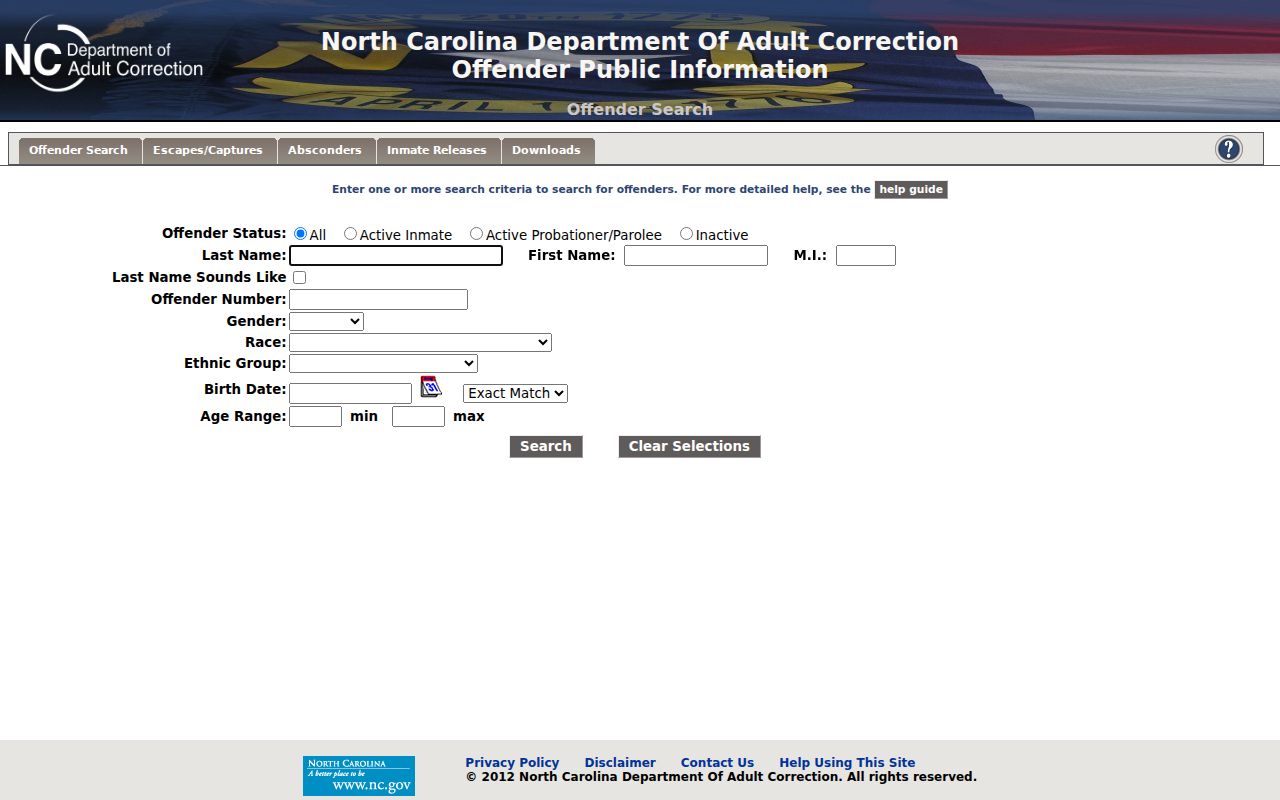
The state locator is the correct next step after a person leaves the county jail for state custody or supervision.
Criminal Records by City in Cleveland County
City police reports remain with the agency whose officer made the report, but North Carolina has no local municipal criminal courts. A Shelby, Kings Mountain, or Boiling Springs arrest can create a city police report, a county detention booking, and a General Court of Justice case. Follow the city record first, then use the correct county jail and Clerk. Kings Mountain crosses the Cleveland-Gaston line, so confirm the event county before selecting the court or jail.
Shelby Criminal History
22,168 · Shelby Police reports route through the department; county cases go to the Cleveland Clerk.
Kings Mountain Criminal History
11,430 · KMPD offers free incident reports, but the event county controls the court route.
Boiling Springs Criminal History
4,752 · BSPD provides an online report request form; court cases remain county records.
Cleveland County Criminal Case Pipeline
After an arrest, a magistrate addresses the first judicial process and release terms. District Attorney 39 decides what the State will prosecute. District Court ordinarily handles misdemeanors, infractions, and early felony stages. A felony indictment moves the case into Superior Court for arraignment, pretrial events, plea or trial, judgment, and sentence. The Clerk keeps both levels.
The District 39 office serves Cleveland and Lincoln counties and explains the prosecutor's role.
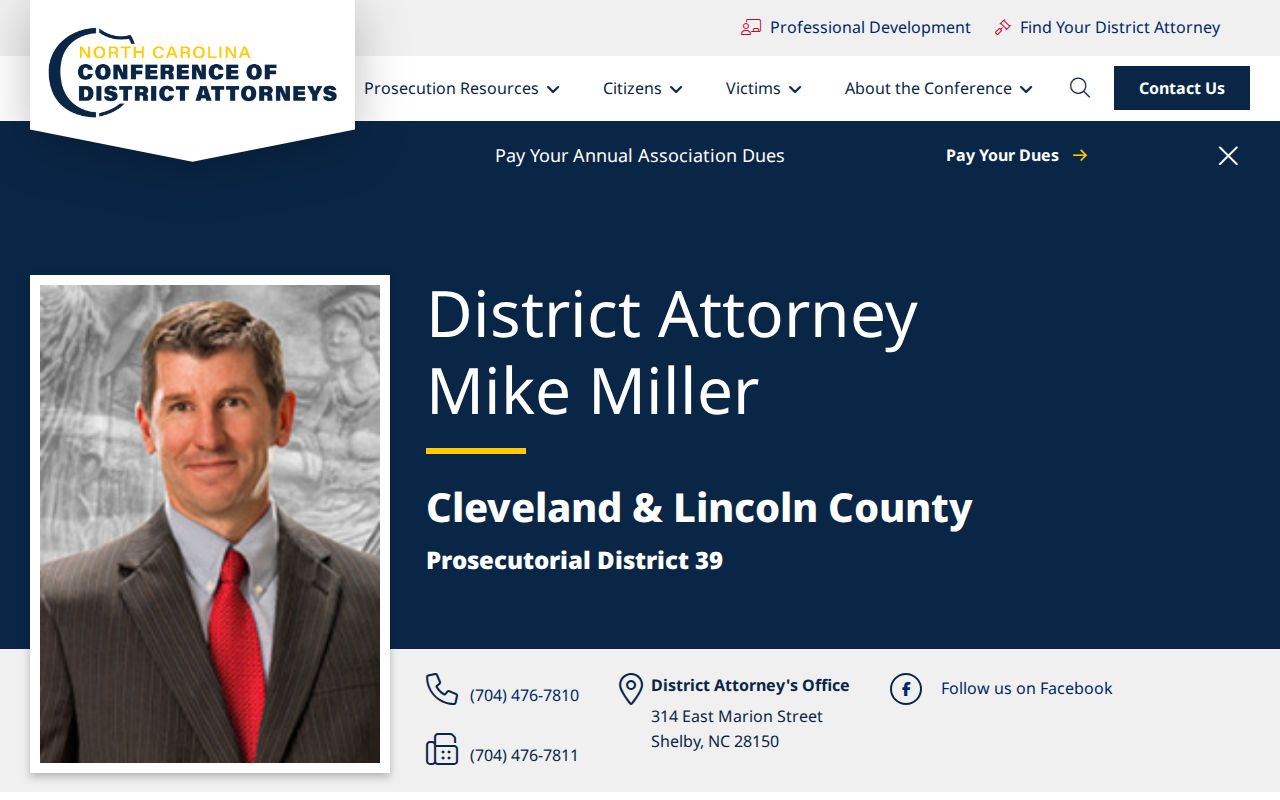
This office affects which allegations become filed charges, but it is not the custodian for public court files.
The Cleveland County public defender listing identifies the local defender office and staff.
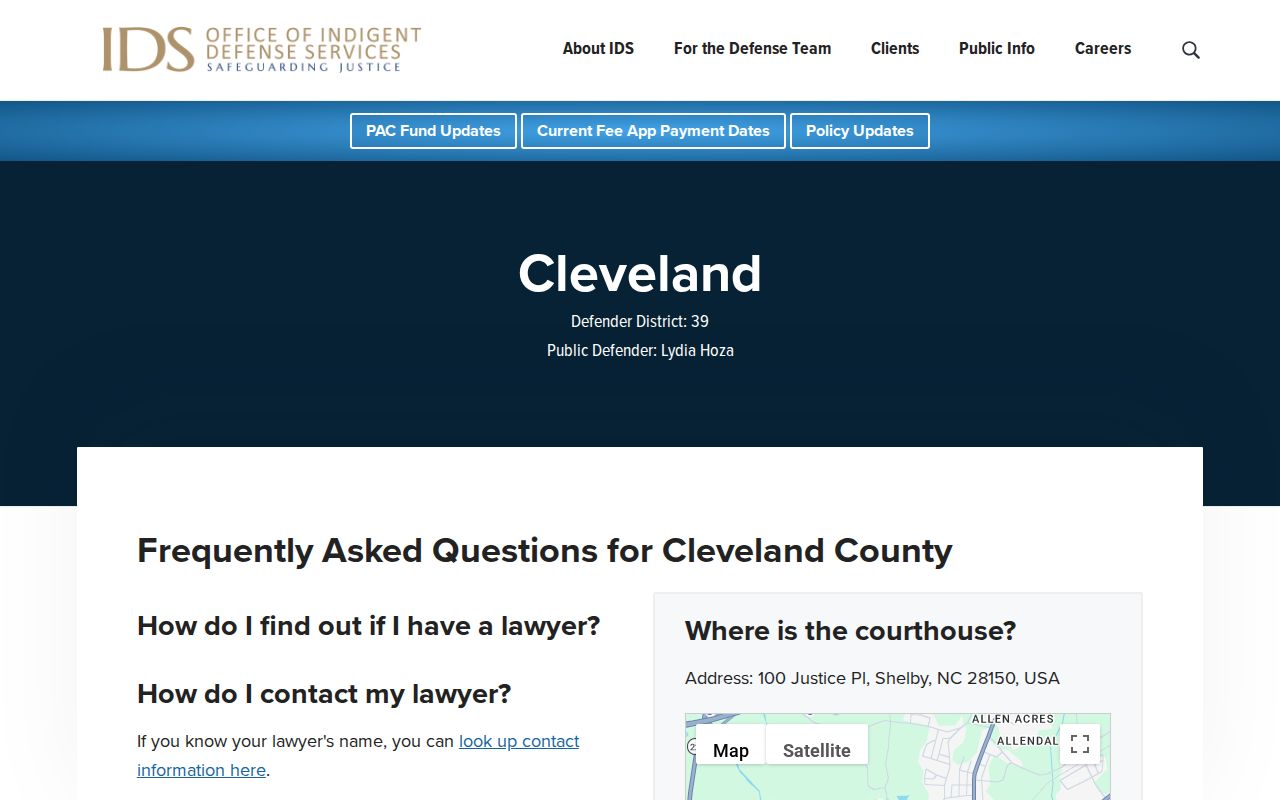
The defender office represents qualifying appointed clients; it does not supply criminal-record searches.